
Autonomous commerce
The next stage of evolution for e-commerce and B2B is already pushing and pioneering its implementation for more than obvious reasons.
What is autonomous commerce?
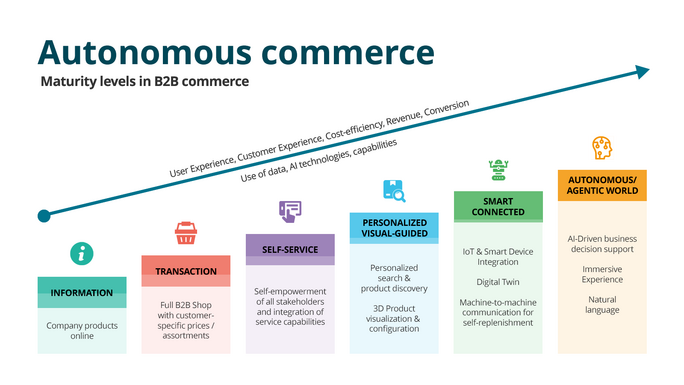
Autonomous commerce refers to the next evolution of digital commerce, where AI, automation, and integrated systems power e-commerce platforms to operate with minimal human intervention. This approach uses advanced technologies to optimize, personalize, and automate processes across the entire e-commerce value chain from procurement to after-sales service.
In B2B, autonomous commerce is especially relevant as it allows businesses to scale, reduce manual workload, and focus on strategic growth. The concept makes use of real-time data, machine learning, and composable commerce architectures to deliver smoother buying experiences that adapt to customers and respond automatically to changing conditions.
What is the main goal of autonomous commerce?
To automate and optimize e-commerce processes, freeing up human resources for strategic tasks and enabling scalable growth.
How is it different from traditional e-commerce automation?
Autonomous commerce goes beyond rule-based automation by using AI and data-driven decision-making to adapt dynamically to market and customer needs.
How is autonomous commerce different than agentic commerce?
While agentic commerce refers specifically to the use of AI agents to automate processes and improve commerce experiences, autonomous commerce is a broader term that encompasses the use of many technologies that support process optimization and automation. This can include agentic AI and generative AI as well as machine learning, algorithmic AI and real-time data.
What are the benefits of autonomous commerce for B2B companies?
1. Increased efficiency & cost savings:
Automates repetitive tasks like inventory management, order processing, and shipping. This increases operational efficiency and reduces costs.
2. Personalized experiences:
Uses AI to tailor product recommendations, pricing, and offers to each customer, boosting satisfaction and conversion rates.
3. Scalability & growth:
Scales business operations effortlessly. By automating core processes and supporting decision-making with AI, companies can focus on innovation and expansion.
4. Data-driven decisions:
Real-time analytics and AI-driven insights lead to smarter inventory, pricing, and marketing strategies.
5. Agility:
Supports rapid adaptation to market changes, customer behavior, and new sales channels through composable commerce and flexible integrations.

“Autonomous commerce is the logical evolution of digital business, enabling companies to react faster and smarter to market demands.”
How autonomous commerce works
Autonomous commerce combines AI-driven engines, automated workflows, and composable commerce architecture. Here’s how it functions:
- Data collection: Continuous aggregation of data from ERP, CRM, storefronts, and IoT devices.
- AI & machine learning: Algorithms analyze data to forecast demand, optimize pricing, and personalize recommendations.
- Process automation: Automated execution of tasks like procurement, order routing, and replenishment – without manual intervention.
- Orchestration layer: API-first platforms (such as Intershop) coordinate the flow of data between systems, monitoring processes and keeping them running smoothly.
- Continuous improvement: AI learns from outcomes, refining processes for even greater efficiency and customer satisfaction.

“Autonomous commerce means building self-running commerce processes that operate with minimal human intervention. It uses automation and workflows to keep sales moving, service consistent, and buying effortless.”
How can Intershop support B2B companies in implementing autonomous commerce?
At Intershop, we're working towards an autonomous, AI-driven future for B2B e-commerce. Our goal is to provide buyers and merchants the best technologies and services to make their work easier. For this reason, we continuously develop the Intershop Commerce Platform and provide technologies that support e-commerce managers in designing commerce experiences that are more efficient and more profitable.
Intelligent search and recommendations: Our AI-powered personalization engine, SPARQUE.AI, gives manufacturers and wholesalers new tools to optimize their conversion rates and increase customer satisfaction through personalized product suggestions.
Low-code integrations: Our Integration Hub pre-integrates key components of your company’s e-commerce stack (ERP, CRM, PIM, etc.) with Intershop for easier data exchange and process automation.
Data fabric and automated orders: Our BI Data Hub can be used to optimize stock levels and forecast sales. In combination with our high-performance order management system, you can automate the entire process of order entry, allocation, and control – from stock management, to shipping and delivery, and even returns.
Automated customer support – the AI-powered Copilot for Buyers provides round-the-clock support for customer inquiries and offers another channel for product discovery, personalization, and upselling. Human agents can provide hands-on support through the Customer Engagement Center with co-browsing and order-on-behalf functionalities.
Together with our customers and partners, we’re building for what’s next – the future of autonomous, AI-driven commerce.
Use cases for autonomouse commerce in B2B
Manufacturing: Automated spare parts ordering based on predictive maintenance, reducing downtime and manual procurement.
Wholesale distribution: Dynamic pricing and inventory management driven by real-time demand and supplier data.
B2B retail: Personalized product assortments and self-service portals that adapt to each customer’s purchasing patterns.
Key technologies behind autonomous commerce
AI & machine learning engines:
For personalized recommendations, demand forecasting, and process optimization.
Composable commerce platforms:
Intershop, enabling modular, API-first integration of best-of-breed solutions.
Automation tools:
For workflow management, robotic process automation (RPA), and customer service bots.
Integration layer:
APIs and middleware to connect ERP, CRM, PIM, and third-party services.
Cloud infrastructure:
Scalable, secure environments for real-time data processing and global reach.
Intershop’s platform offers a robust foundation for autonomous commerce, with out-of-the-box automation, AI capabilities, and easy integrations.

Ready to unlock the power of autonomous commerce?
Intershop’s platform offers a robust foundation for autonomous sommerce, with out-of-the-box automation, AI capabilities, and seamless integrations.